Deepfake Detector Apps: 7 Things to Check Before You Trust One
Not all deepfake detector apps are equal. Here are the 7 things that separate a trustworthy AI detector from a coin flip — privacy, multi-signal analysis, honesty and more.
Search “deepfake detector” in any app store and you’ll find dozens of results with confident names and 99% accuracy claims. Some are serious forensic tools. Some are a thin interface over a single cloud model. A few are outright scams harvesting the very photos you’re worried about.
We build one of these apps, so we’re openly biased — but that’s also why we know exactly which questions expose a weak detector. Here are the seven that matter, whatever tool you end up choosing.
1. Where does the analysis run?
The single most consequential question. If the app uploads your media to a server, then the photo you’re worried about — often something private — now lives on someone else’s infrastructure, subject to their retention policy, their security and their breach history. Look for explicit wording: on-device means the file never leaves your phone; “secure cloud processing” means it does leave, just politely.
On-device analysis also works offline and starts instantly — no upload queue for a 4K video. We’ve written a full breakdown of the trade-off in on-device verification, explained.
2. One model, or multiple independent signals?
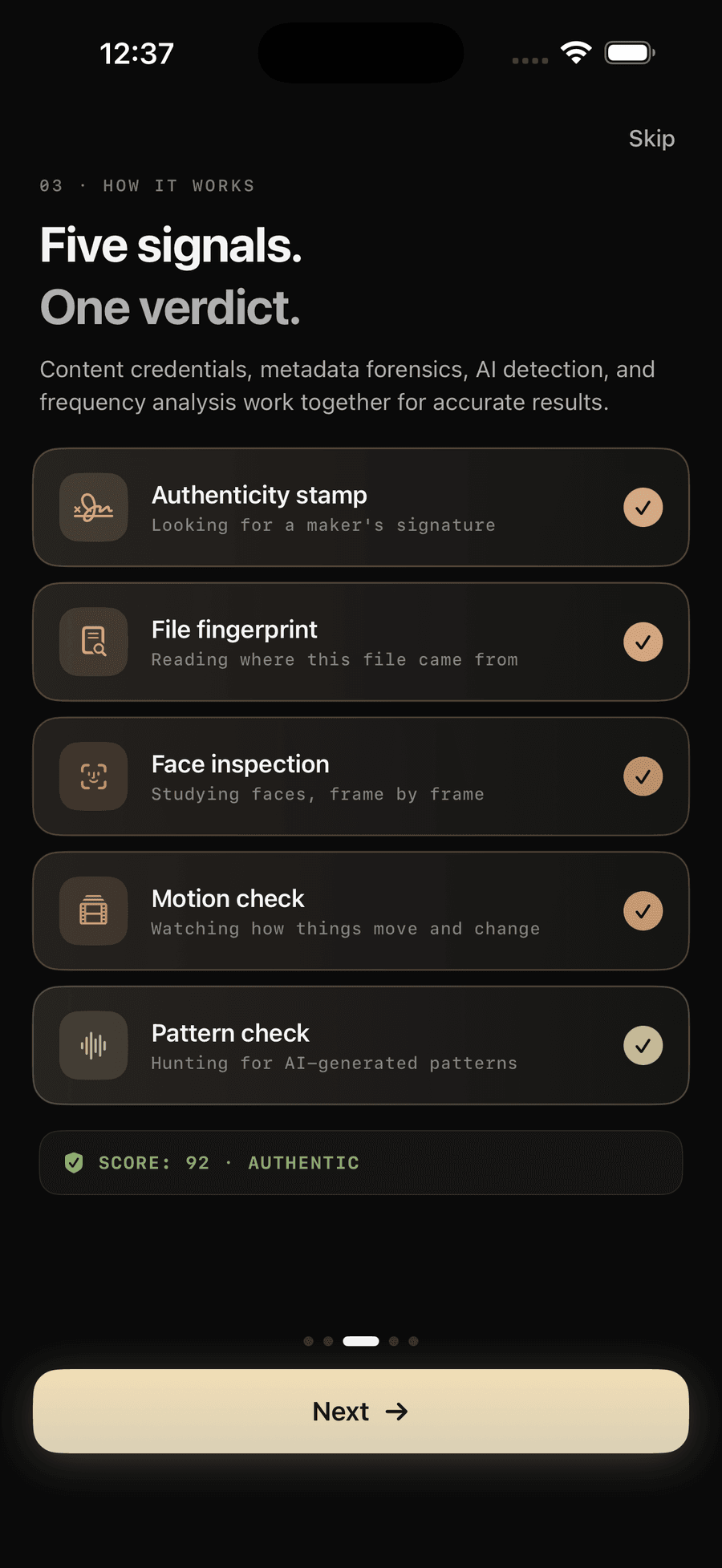
A detector that runs your file through a single neural classifier is a monoculture: whatever fools that model fools the whole product. Serious tools fuse independent signal families — provenance credentials, metadata and encoding forensics, neural face analysis, motion/temporal consistency, frequency-domain fingerprints. Fooling one signal is easy; fooling all of them simultaneously is what’s hard. If the marketing can’t tell you what signals it checks, assume it’s one model in a trench coat.
3. Does it explain itself?
A bare “FAKE ✅ / REAL ❌” is not analysis, it’s an oracle. You should see why: which layers fired, what the metadata said, whether provenance was present, what the confidence per signal was. Explanations let you weigh the verdict against context — and they keep the tool honest, because unexplained verdicts can’t be audited by anyone.
4. Does it ever say “inconclusive”?
This one is counterintuitive: the trustworthy detector is the one willing to shrug. Heavily compressed, screenshotted, re-uploaded social media content destroys much of the forensic evidence any tool relies on. Real accuracy on clean images (roughly 85–94% for good detectors in 2026) drops meaningfully on degraded ones. A tool that returns a confident verdict on everything is not more capable — it’s less honest. Look for a confidence score and an explicit uncertain state, not a binary.
5. What does it actually support?
Check the boring specifics against your real use case:
- Video, not just images — frame-by-frame analysis, not a single thumbnail.
- Link analysis — paste a URL from a social platform instead of downloading first.
- Share-sheet integration — verify directly from Photos or your browser.
- Common formats — HEIC and MOV matter on iPhone, not just JPEG and MP4.
6. What’s the business model?
You are either the customer or the product. An app with no visible way of making money, broad photo-library permissions and a cloud pipeline deserves suspicion — training-data harvesting dressed as a free tool is a real pattern. Clear pricing (a free tier plus a paid one) is a good sign, not a bad one.
7. Does it claim certainty?
Deepfake detection is an arms race; generators improve constantly, and every honest vendor says so. Treat absolute claims — “100% accurate”, “detects all AI” — as disqualifying. The realistic promise is strong evidence, updated over time, from multiple independent signals. Anyone promising proof is selling you the one thing this field cannot deliver.
How Verifyco answers these seven
Since these are the questions we’d want asked of us: Verifyco runs entirely on-device on iPhone (nothing is ever uploaded, no account exists), fuses five independent forensic signals — C2PA provenance, metadata forensics, neural face analysis, motion consistency, frequency analysis — into a 0–100 confidence score with a per-layer breakdown, returns inconclusive when the evidence genuinely doesn’t support a verdict, supports photos, videos and pasted links with a share extension, and has plain pricing (three free analyses, subscriptions after). The methodology behind the score is the same one we document publicly in guides like how to tell if an image is AI-generated.
Frequently asked questions
What accuracy should I expect from a deepfake detector app? On clean, uncompressed media, good multi-signal detectors operate around 85–94% in 2026. On compressed social media re-uploads, meaningfully lower — which is why honest tools report confidence and uncertainty instead of a flat yes/no.
Are free deepfake detector apps safe to use? Some are; some monetise your uploads. Before giving any app a sensitive photo, check where analysis runs (on-device vs cloud), the privacy policy’s retention terms, and whether the business model is visible. Free tiers of paid products are generally safer than entirely free cloud tools.
Can any app detect deepfakes with certainty? No. Detection is probabilistic and generators evolve. A trustworthy app gives you strong, explained evidence — multiple signals, a confidence score, honesty about limits — and leaves the final judgement, plus context like the source, to you.
Do I need a detector app if I can check credentials and metadata myself? They’re complementary. Credentials and provenance are the fastest check when present, but most viral content has them stripped. Forensic signal analysis is what’s left when the easy evidence is gone — see our iPhone photo-checking walkthrough.
The bottom line
The right question isn’t “which detector says REAL or FAKE” — it’s which detector earns trust: private by architecture, multi-signal by design, and honest about uncertainty. Ask the seven questions above of any tool, including ours.