How to Tell If an Image Is AI-Generated
A practical, forensic checklist for spotting AI-generated images — from telltale visual artifacts to the metadata and signals that actually hold up.

AI image generators have gotten good — fast. The obvious tells from a year ago (six-fingered hands, melted text) are mostly gone, and a convincing fake now takes seconds to produce. The good news: generated images still leave evidence. You just have to know where to look.
This is a quick field guide. Treat it as a checklist, not a verdict — no single sign is proof on its own. Real confidence comes from stacking multiple independent signals.
1. Look closely at the hard parts
Generators struggle with details that require global consistency rather than local plausibility. Zoom in and check:
- Hands, teeth and ears — counts and proportions still drift.
- Text in the scene — signage, labels and logos often dissolve into pseudo-letters under magnification.
- Reflections and shadows — light direction that doesn’t agree across the frame is a strong tell.
- Repeating textures — hair, foliage and crowds can show uncanny, tiling-like repetition.
2. Check the metadata
Every real camera writes a trail. AI images usually don’t — or they write the wrong one.
- Missing EXIF (no camera make/model, no lens, no exposure) on a photo that claims to be a snapshot is suspicious.
- Generator signatures sometimes appear directly in the metadata, e.g. a
Softwarefield naming the tool. - C2PA Content Credentials are the opposite signal: a cryptographically signed receipt that proves where a file came from. Their presence is strong evidence for authenticity.
Metadata can be stripped or faked, so absence isn’t proof — but it shifts the burden of evidence.
3. Read the frequency fingerprint
This is the part you can’t do by eye. Diffusion and GAN models leave statistical patterns in an image’s frequency spectrum — regularities that don’t occur in light captured through a real lens. A spectral (DCT) analysis surfaces these even when the image looks flawless at normal magnification.
4. Don’t trust a single signal
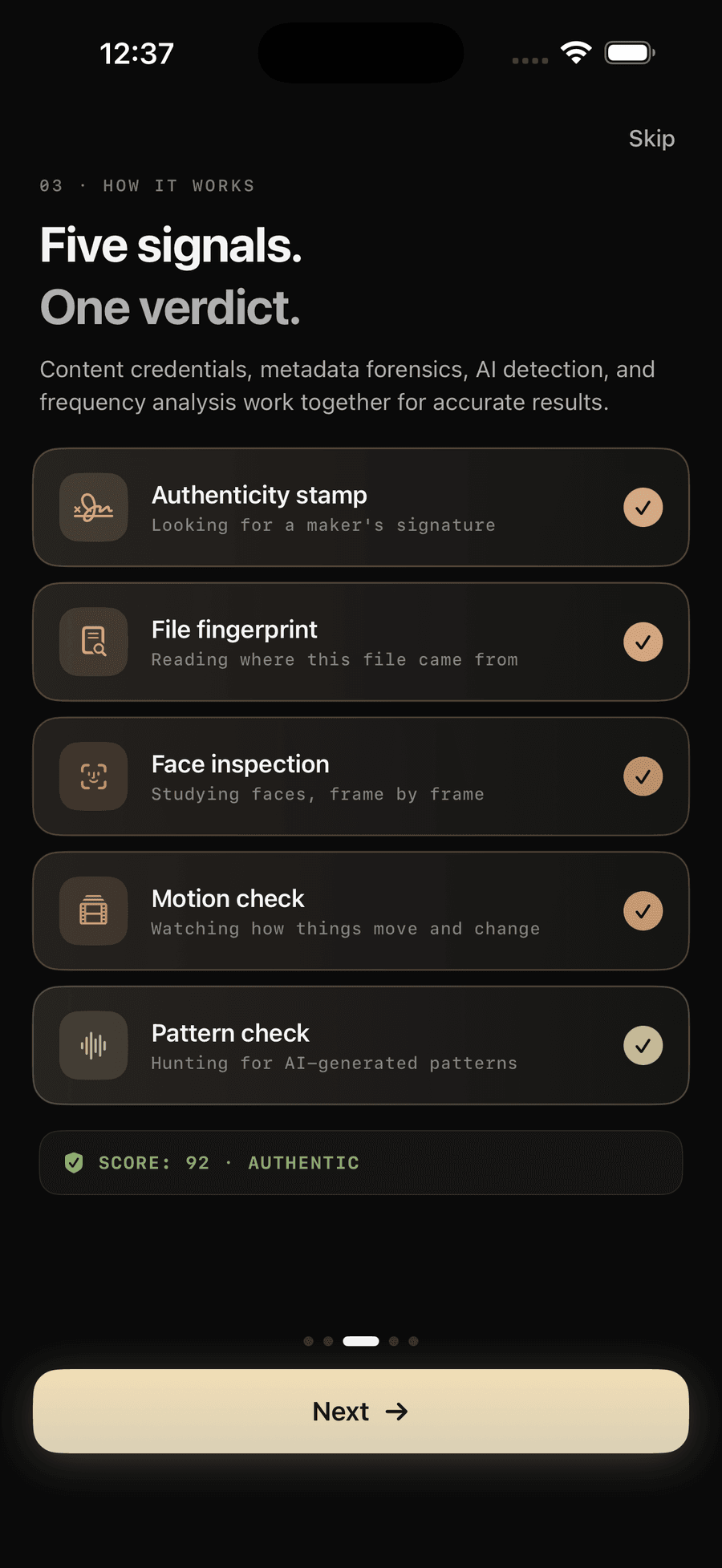
The mistake most people make is hunting for one smoking gun. Modern detection works by fusion: combining content credentials, metadata forensics, neural face analysis and frequency analysis into one score. Any one layer can be fooled; all of them at once is much harder.
That’s exactly how Verifyco works — five independent signals on-device, fused into a single 0–100 trust score, so you get a verdict you can actually reason about.