AI Voice Cloning Scams: How to Protect Yourself in 2026
Scammers can clone a voice from three seconds of audio. Learn how AI voice cloning scams work, the red flags of a fake voice call, and the habits that actually protect you.
The phone rings. It’s your daughter’s number — or a number you don’t know, but it’s her voice, panicked, asking for money fast. Except it isn’t her. It’s a clone, generated from a few seconds of audio scraped from a social video, and the person behind it is running one of the fastest-growing scams in the world.
AI voice cloning scams have exploded because the ingredients got cheap. Modern voice models need as little as three seconds of clean audio to produce a convincing clone, and most people have far more than that publicly available — voicemail greetings, Instagram stories, TikToks, podcast clips, even a “hello?” recorded by a robocall. This guide explains how the scam works, the red flags to listen for, and the simple family protocol that defeats it.
How a voice cloning scam actually works
The playbook is consistent across countries:
- Harvest. The scammer collects a short voice sample of the person they’ll impersonate — usually from public social media.
- Clone. Off-the-shelf tools turn the sample into a text-to-speech voice, or a real-time voice changer the scammer speaks through.
- Trigger panic. They call a relative or colleague with an emergency script: an accident, an arrest, a kidnapping, an urgent invoice. Panic is the whole strategy — a frightened brain doesn’t verify.
- Move the money irreversibly. Wire transfer, gift cards, crypto, courier pickup — channels with no chargeback.
The corporate version is identical, just aimed at finance teams: a “CEO” calls or leaves a voicemail approving an urgent transfer. The famous Arup case — a finance employee who wired ~$25M after a video call full of deepfaked colleagues — shows how far the combined video + voice version has come. (We break that case down in how to spot a deepfake video.)
Red flags of a cloned voice call
No single tell is proof, but cloned calls tend to share these:
- Urgency plus secrecy. “Don’t tell mum”, “the lawyer says not to talk to anyone”. Real emergencies rarely require secrecy; scams always do.
- A payment channel with no undo. Gift cards, crypto, wire transfers, couriers collecting cash. This is the strongest signal of all.
- The voice is right, the rhythm is wrong. Cloned voices often have flattened emotion, odd pacing, unnatural breathing (or none), and a subtle metallic edge — especially on long sentences.
- They dodge open-ended questions. Clones (and the scammers driving them) struggle with specifics: “What did we have for dinner last Sunday?” derails a script instantly.
- Background noise that cuts unnaturally between words, or a voice that never overlaps yours the way real conversation does.
- Caller ID means nothing. Numbers are trivially spoofed. A call appearing to come from a loved one’s number proves nothing.
The family password: the cheap defence that works
Security teams now recommend the same thing for families that they recommend for companies: a pre-agreed verification phrase that never gets written in chats or posted anywhere.
- Pick a random phrase — not a pet’s name, not anything guessable from social media.
- Agree on it in person with the people who might ever call you in an emergency.
- The rule is absolute: money or sensitive requests by phone require the phrase, no matter how real the voice sounds.
And the universal fallback if there’s no phrase: hang up and call back on the number you already have for that person. Not the number that called you — your own saved contact. A real relative won’t mind. A scammer can’t survive it.
Protect your voice (and your family’s)
You can also shrink the attack surface:
- Lock down old public videos where clean voice audio is easy to grab, especially for kids and elderly relatives.
- Replace personalised voicemail greetings with the default robot voice.
- Don’t answer unknown callers with a long “Hello? Hello? Who is this?” — that’s a free sample. Silence until they speak costs a scammer more than it costs you.
- Brief the most-targeted family members: grandparents are the classic target of the “grandchild in trouble” script.
Can software detect a cloned voice?
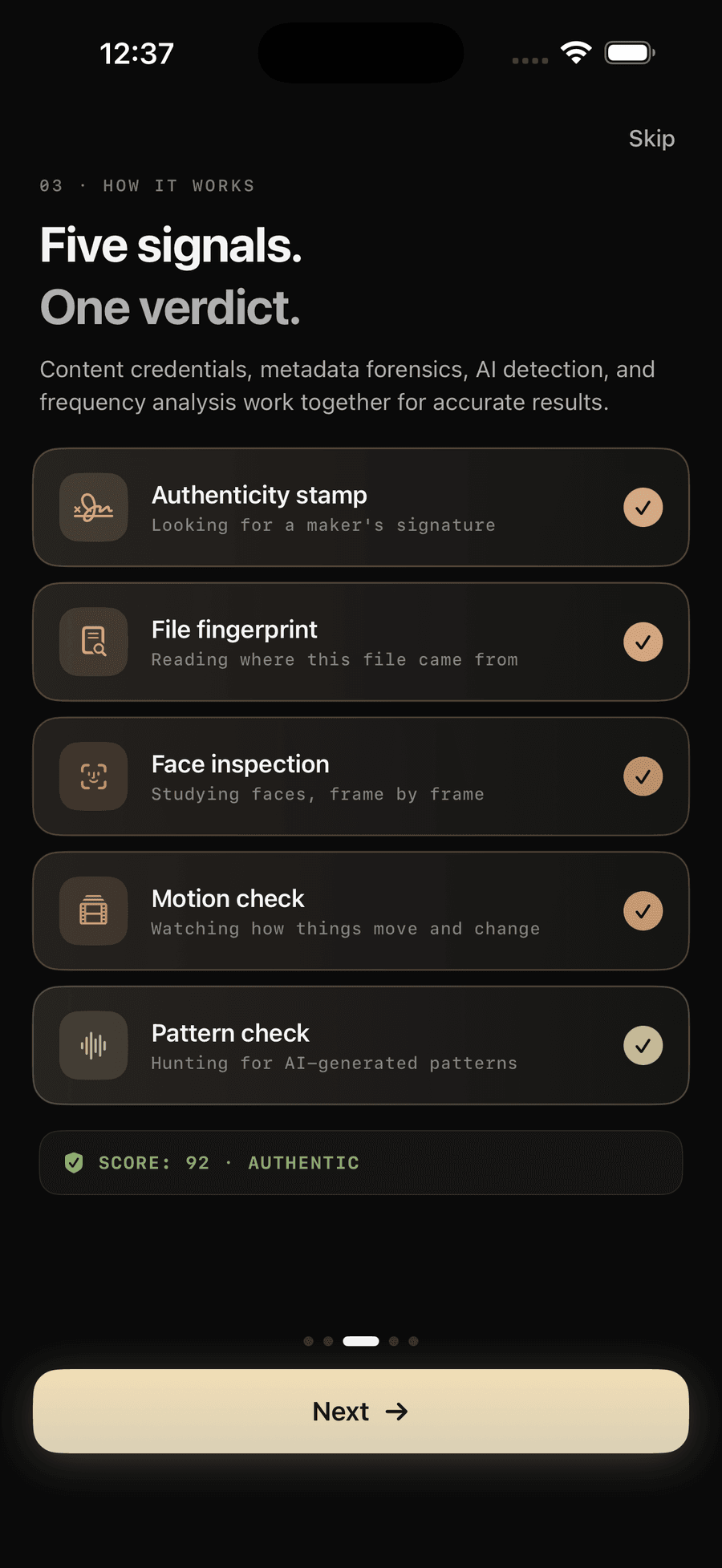
Increasingly, yes. Synthetic speech leaves statistical fingerprints — spectral artifacts, unnatural pitch dynamics, missing room acoustics — that forensic analysis can flag even when ears can’t. That’s the same principle behind multi-signal media forensics: no single check decides, but independent signals combined are hard to fool on all fronts at once. Verifyco applies that approach to photos and videos directly on your iPhone — including the audio track of a video you’ve been sent — fully on-device, so the suspicious clip never leaves your phone. (Why on-device matters: on-device verification, explained.)
For a live phone call, though, no app can sit between your ear and a scammer in real time. That’s why the protocol above matters more than any tool: verification beats detection when money is on the line.
Frequently asked questions
How much audio does it take to clone a voice? Modern models produce a usable clone from roughly 3–10 seconds of clean speech, and a very convincing one from a minute or two. Almost everyone with any social media presence has already published enough.
Can I tell a cloned voice by ear? Sometimes — listen for flat emotion, strange pacing, missing breaths and a metallic edge. But quality improves every year, and under panic your ear is at its worst. Treat voice alone as zero proof of identity for any request involving money.
What should I do if I get a suspicious emergency call? Slow it down. Ask a question only the real person could answer, or ask for your family phrase. Then hang up and call the person back on their saved number. If money already moved, contact your bank immediately and report the fraud to the police.
Does caller ID showing a family member’s number mean it’s really them? No. Caller-ID spoofing is trivial and widely used in these scams. The voice and the number can both be fake at the same time.
The bottom line
Voice is no longer proof of identity. The defence isn’t paranoia — it’s a habit: a family password, and a call-back on a number you trust before any money moves. New to synthetic media? Start with what is a deepfake, then learn the video-side tells in 5 signs a video has been deepfaked.